The Bradford-Renduchintala Centre for Space AI
Study with us
Two degrees supported by the Bradford-Renduchintala Centre for Space AI, where space technology, electronics and artificial intelligence come together. Learn from a research-active team and use the Centre's labs and facilities during your studies.
MSc Artificial Intelligence and Space Technology
- Award
- MSc
- Study mode
- Full-time (1 year) or part-time (2 years)
- Start date
- September
- Location
- City Campus, Bradford
- Suitable for
- UK and international applicants

Overview
This unique Master's in Artificial Intelligence and Space Technology is the first of its kind in the UK.
The programme is co-designed and co-delivered with industry. It aims to provide you with state-of-the-art knowledge and industry-ready skills for several of the top fastest growing jobs, as identified in the World Economic Forum's Future of Jobs Report 2025.
It equips you for a career in either the booming space sector (with the global space economy projected to grow to £490 billion by 2030), or in AI and Data Analytics (which are among the world's top 3 fastest growing jobs).
You will develop excellent grounding and skills in:
- the space ecosystem and its various enabling technologies
- machine learning (ML)
- big data analytics and visualisation
- advanced applications of AI in space data and systems
You will learn how space technology plays a critical role in our daily lives. Satellites orbiting over 160 km from the Earth can:
- connect us with our friends, families and colleagues
- facilitate road, ocean and air navigation
- support homeland security and disaster relief
- enable smart and sustainable agriculture
- forecast the weather
- gather vital information about our planet, such as greenhouse gas concentration, melting glaciers and polar ice, deforestation and land use, ocean acidification, coral reef health and much more
You will qualify as a data scientist and AI/ML engineer who understands space technologies including geospatial, navigational, communication, exploration and space cybersecurity. You will be able to fill various roles within the space industry, or apply your AI and data analytics skills to work in other sectors of the economy. You may also choose to study further towards a PhD.
What you will study
Core modules
- Big Data Systems and Analytics
- Advanced Machine Learning
- Space Ecosystem and Enabling Technologies
- Applied AI in Space Data and Systems
Optional modules
- Big Data Visualisation
- Responsible AI: Ethics, Law and Governance
- Earth Observation Satellite
- Digital Signal Processing Systems
Entry requirements
2:2 or above in a science, technology, engineering, or mathematics discipline, from an approved degree awarding body.
Candidates who do not fulfil the normal entry requirements but have extensive industrial experience in a related area will be considered on an individual basis.
English language requirements
Minimum IELTS 6.0 or equivalent, with at least 5.5 in each subtest or GCSE English Language at grade C/4.
Fees for 2027/28 entry
| Home | International | |
|---|---|---|
| Full-time | £10,189 | £16,092 |
| Part-time | £5,094.50 | Under review, to be confirmed |
The University awards non-repayable scholarships every year to UK, EU and international students on the basis of academic excellence, personal circumstances or economic hardship. Fees for other entry years are on the University course page.
Career prospects
After graduating from this course, your career prospects include employment as a big data specialist or an artificial intelligence/machine learning engineer. You could also pursue roles in the space industry, in research within industry and other organisations, or in entrepreneurship as a job creator.
BEng (Hons) Electronics and Artificial Intelligence Engineering
- Award
- BEng (Hons)
- Study mode
- Full-time
- Duration
- 3 years, or 4 years with a placement year or an Integrated Foundation Year, or 5 years with both
- First intake
- September 2027
- Location
- City Campus, Bradford
- Suitable for
- UK and international applicants
Overview
This is a new and innovative undergraduate programme developed by the University of Bradford and the Bradford-Renduchintala Centre for Space AI to address a nationwide skills gap at the intersection of electronics and advanced software skills. It is underpinned by UK-wide strategies and initiatives such as the Space Sector Skills Survey 2023, the Skills England Annual Skills Report and the Sectoral Skills Needs Assessments 2026, and aligns with the UK's Modern Industrial Strategy, which identifies electronics and software skills as a priority area.
The programme is:
- Informed by future-facing engineering priorities, with its design guided by the Royal Academy of Engineering and Engineers Without Borders report on Engineering in 2030.
- Developed in collaboration with industry partners and features their materials, software and guest speakers, so you build industry-informed, employment-relevant skills.
- Built on industry-standard hardware and software, taught by staff with industry certifications from companies like Nvidia.
It will appeal to students who want practical, hands-on experience with modern electronics and to combine it with AI, machine learning and other accelerated computing technologies to create new products, devices, systems and services. Alongside these technical skills, you will develop professional skills such as sustainability and responsible innovation, ready to work across discipline boundaries on the complex problems of tomorrow.
Professional accreditation
The programme will seek accreditation from the Institution of Engineering and Technology (IET) and BCS, The Chartered Institute for IT. In the meantime, it is designed to align with their standards and requirements for partial Chartered Engineer (CEng) and full Chartered IT Professional (CITP).
What you will study
Year 1
- Technical and Professional Skills
- Skills for Industry
- Mathematical Methods and Applications
- C Programming
- Linear and Analog Electronics
- Computer Architectures and Systems Software
Year 2
- Applied Sustainability for Technical Managers
- Artificial Intelligence
- Computer Communications and Networks
- Wireless Communications and Internet of Things
- Embedded Systems – Microcontrollers
- PCB Design
Year 3
- Final Year Project
- Machine Learning
- Cyber Security
- Embedded Systems – Linux
- GPU Programming
All module information is for 2027 entry and is subject to change.
Labs and facilities
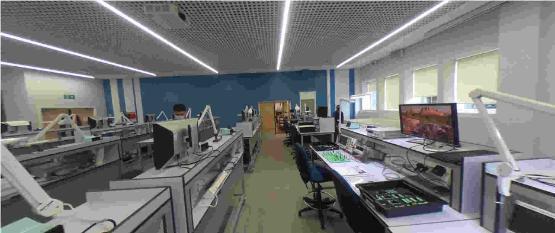
You will have access to a recently refurbished, dedicated Electronics lab with excellent technical support, modern equipment from Keysight, and a range of development kits such as microcontroller boards and Nvidia Jetson boards.
You will also benefit from the specialised facilities of the Bradford-Renduchintala Centre for Space AI, such as a Satellite Observation and Control Room, a Weather Monitoring Station, a Software-Defined Satellite Testbed and an Anechoic Chamber. You will be welcome to join the Very-small-satellite Innovation Project Club, an extracurricular series of activities focused on designing, developing and building small satellites.
Placement year and study abroad
You can choose to add a placement year, applying what you have learned in industry, the public sector or the not-for-profit sector. You will build a professional network and develop skills such as communication, problem-solving and entrepreneurship, with support for finding placements, writing your CV and preparing for interviews.
You can also take up opportunities to study, work or volunteer abroad, in more than 150 countries across the world, with support every step of the way.
Entry requirements
| BEng (Hons), 3 years | With Integrated Foundation Year | |
|---|---|---|
| Typical offer | 112 UCAS points | 72 UCAS points |
| A levels | BBC | DDD |
| BTEC Extended Diploma | DMM | MPP |
| Access programmes | 104 UCAS points | 64 UCAS points |
| T levels | Accepted | Accepted |
Plus A-level Maths at grade C or above, and GCSE English Language and Maths at grade C or 4 (equivalents accepted).
Candidates who do not fulfil the normal entry requirements but have extensive industrial experience in a related area will be considered on an individual basis. Mature applicants (aged 21 and over) can apply with level 2 qualifications (or GCSE equivalents), together with a written statement and an interview. We also welcome direct entry applicants into Year 2 and Year 3; please contact the Programme Leader to discuss.
English language requirements
Minimum IELTS 6.0 or equivalent, with at least 5.5 in each subtest or GCSE English Language at grade C/4.
Fees
Tuition fees for 2027/28 entry will be confirmed by the University.
After you graduate
You will graduate as a technically capable engineer, confident working on complex, interdisciplinary projects across electronics, software engineering and AI, and able to design and develop ethical, safe and sustainable products and services. You will be eligible to become a member of professional engineering organisations such as the IET and BCS.
You will also be well prepared for further study at MSc or PhD level, including the Centre's own MSc Artificial Intelligence and Space Technology.
This course starts in September 2027. All course information is for 2027 entry and may change before the course opens.
Why study with the Space AI Centre?
The entire course team is research-active within the Bradford-Renduchintala Centre for Space AI. The Centre has a long research track record in space technologies and AI, and strong collaborations with industry.
The team is a founding member of the Satellite Network of Excellence (SatNEx), established in 2004 and funded first by the European Union and currently by the European Space Agency. One example of its many research achievements is the Automated Solar Activity Prediction (ASAP) system, acknowledged as an international benchmark and deployed in NASA's Solar Dynamics Observatory, as well as being among the UK's space weather assets.
Your learning will be supported by research data from the Centre's facilities for satellite beacon, meteorological and atmospheric monitoring, and by data and facilities from collaborating companies. Some of the case studies you meet in class will come from current research challenges, and you may have the opportunity to work alongside our PhD students and postdoctoral research fellows on externally funded research projects.
Contact us
Have a question about either programme? Get in touch with the course team.
For questions about applications, you can also contact the University's Admissions Team at admissions@bradford.ac.uk or 01274 236088.